

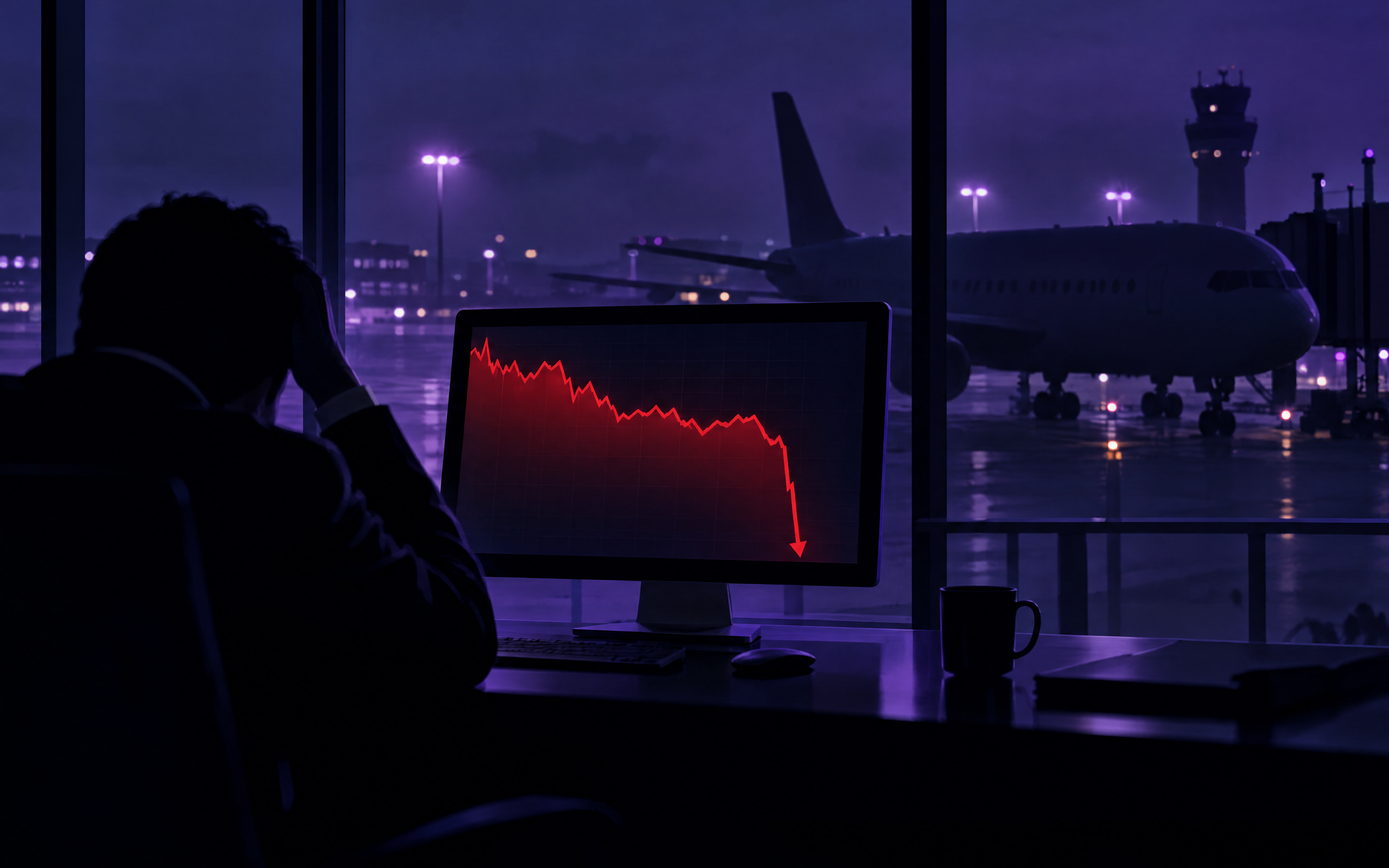
The UAL Corp glitch refers to the episode of September 8, 2008, when shares of United Airlines (UAL Corp) fell by about 76% within minutes, dropping from 12.30 dollars at the previous Friday’s close to an intraday low of 3 dollars, after an undated republication of an article describing the carrier’s 2002 bankruptcy, according to the Los Angeles Times.
Nothing in this episode points to deliberate manipulation. It was a chain of technical and human errors, each trivial on its own, that was enough to collapse the market valuation of a Nasdaq-listed airline for roughly twenty minutes.
A 2002 article republished with no visible date
The starting point traces back to a Chicago Tribune article published on December 10, 2002, reporting United Airlines’ Chapter 11 bankruptcy filing, a process the carrier had exited in February 2006. According to Reuters, the Sun-Sentinel, a newspaper from the same press group, never explained how that article ended up on its site with no visible publication date over the weekend of September 6 and 7, 2008, even though no one on the editorial staff had reopened that file since 2003.
According to Tribune Co., cited by Poynter, a single isolated visit shortly after 1 a.m. Eastern Time on Sunday was likely enough to place the article among the five most-viewed business articles on SunSentinel.com, since overnight traffic was then extremely low. That automated ranking, followed by one or two more clicks, triggered indexing of the page by Google’s crawler, which dated it to the day it was crawled rather than its actual publication date.
A hurried reader turns an old story into breaking news
According to NPR, an employee at a financial analysis firm was running a Google search about recent bankruptcies when he came across this article at the top of the results. Believing he was reading same-day news, he forwarded it to a subscription service whose content was then relayed on the Bloomberg wire, without checking the article’s actual publication date. No source establishes the exact identity of this employee or the precise text of Google’s indexing algorithm at that time: only the sequence of events is documented.
Because the Bloomberg wire is followed by many market professionals, the information spread almost instantly among traders, who sold UAL shares without taking the time to verify the original article’s date.
The stock’s crash and the Nasdaq trading halt
According to CNBC, the stock opened the September 8, 2008 session at 12.17 dollars on the Nasdaq before plunging. The Los Angeles Times reports an intraday low of 3 dollars, a drop of about 76% from the previous Friday’s close of 12.30 dollars. After roughly 13 minutes of sharp decline, the Nasdaq halted trading in the stock for about 90 minutes while it examined the cause of the drop.
When trading resumed, the exchange operator ruled on the fate of trades already executed. According to the Los Angeles Times, the Nasdaq announced it had reviewed trades executed between 10:55 and 11:08 a.m. Eastern Time and decided that all of them would stand, with no right of appeal. The stock ultimately closed the session down 11.22%, at 10.92 dollars, a much more modest decline than the intraday plunge but a real one nonetheless.
| Moment | Price or change | Source |
|---|---|---|
| Previous Friday’s close | 12.30 dollars | Los Angeles Times |
| Open on September 8, 2008 | 12.17 dollars | CNBC |
| Intraday low | 3 dollars (about -76%) | Los Angeles Times |
| Close on September 8, 2008 | 10.92 dollars (-11.22%) | CNBC |
United Airlines’ response
United Airlines issued a statement calling the circulating bankruptcy reports entirely false, and directly blamed the Sun-Sentinel site for republishing a six-year-old article with a modified date, demanding a retraction and announcing an internal investigation. The episode later fueled debate over the responsibility of search engines and automated financial news feeds in verifying publication dates, a question none of the sources consulted resolve definitively.
Frequently asked questions
Is the UAL Corp glitch linked to fraud or market manipulation?
No. According to the sources consulted, the chain of events started from a technical indexing error and a hasty reading of an old article, with no intent to harm the stock’s price identified in reporting from that time.
Why didn’t the Nasdaq cancel the trades made during the crash?
The Nasdaq reviewed trades executed between 10:55 and 11:08 a.m. Eastern Time and decided that all of them would stand, a decision presented as not subject to appeal according to the Los Angeles Times.
Did UAL Corp stock stay at 3 dollars after the incident?
No. After the roughly 90-minute trading halt, the stock closed the September 8, 2008 session down 11.22%, at 10.92 dollars, far from the intraday low of 3 dollars.
How could a 2002 article appear recent in 2008?
According to Poynter, a single isolated visit early Sunday morning was likely enough to make the article appear among the site’s most-viewed content, which led Google’s crawler to index it as though it were recent.
To better understand the market mechanisms discussed here, a related article details a comparable technical incident: the J-Com error. The role of trading halts like the one applied to UAL Corp stock is explained in the article on US market circuit breakers. According to the Los Angeles Times, the Nasdaq published its decision to let the trades stand in a statement dated September 8, 2008, available at latimes.com.